
What is sump pump discharge line repair?
Discharge line repair fixes the piping that carries water away from the sump pit — clearing clogs, repairing leaks, replacing failed check valves, and correcting routing so water actually leaves the system.
The discharge line is the part of the system most people never see, but it is where many failures begin. If the line is blocked, the pump pushes against a closed system. If it leaks or drains back toward the house, the same water is moved again and again.
Discharge problems are among the most common reasons a working pump appears to fail, and they are usually repairable without a full sump pump replacement.
That distinction — a blocked line versus a dead pump — is one of the most valuable things to understand about the system.
Why the discharge line matters
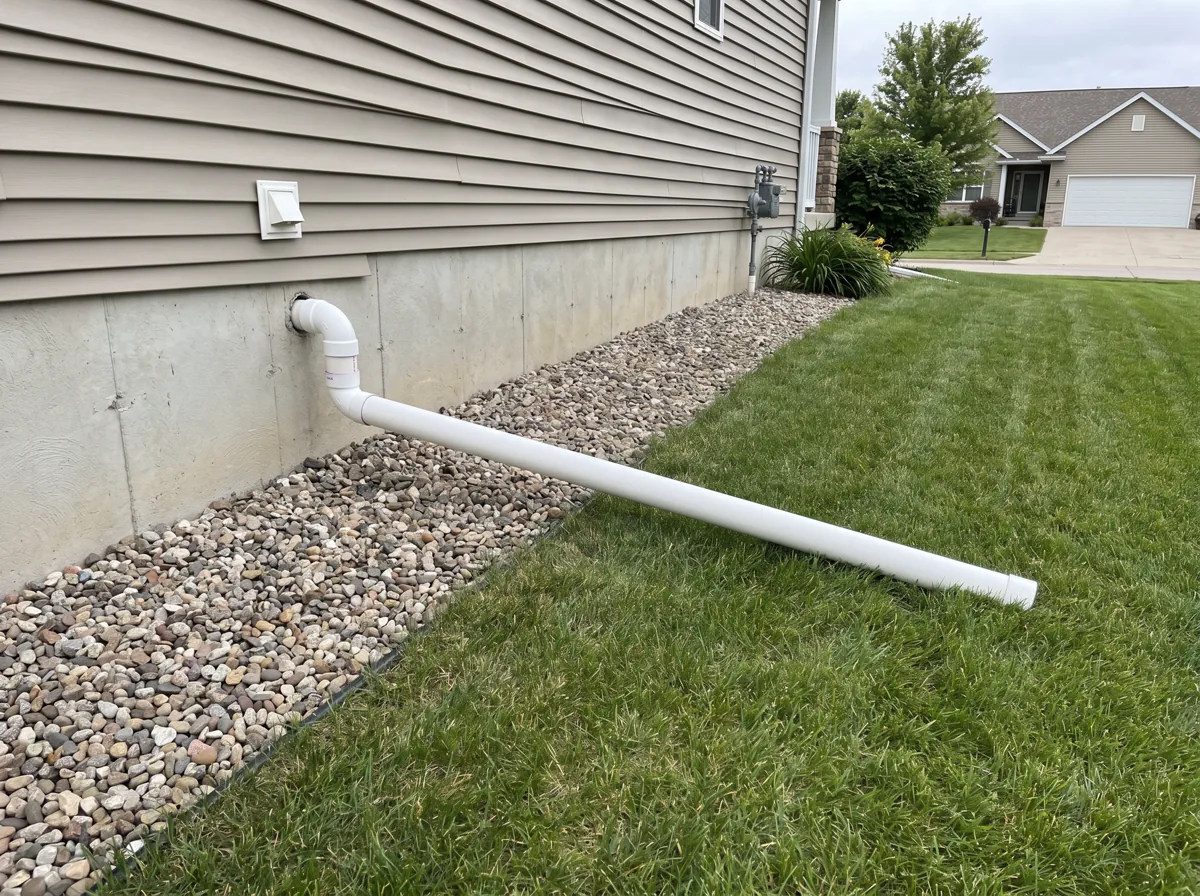
The discharge line is the pump's exit path. It begins at the pump, passes through a check valve, rises out of the pit, and runs to an outlet away from the foundation. For the system to work, water must flow freely along the entire path and drain away at the end.
A well-routed discharge line slopes downward so water drains out after each cycle. When routing is wrong, water pools in the pipe and can freeze in cold weather or drain back toward the house, undoing the pump's work.
Common discharge line problems
| Problem | What happens |
|---|---|
| Clogged line | Debris or sediment blocks flow, forcing the pump to work against a closed system. |
| Frozen line | Low spots hold water that freezes in cold weather, blocking outflow entirely. |
| Failed check valve | Water runs back into the pit, causing the pump to cycle repeatedly. |
| Leaking joints | Water escapes along the pipe and can end up right back near the foundation. |
| Poor routing | The line ends too close to the house or lacks slope, so water returns to the system. |
Frozen discharge lines in winter
In a cold Midwestern winter, a discharge line that holds water in a low spot can freeze solid, blocking the entire system. The pump keeps running against the ice, working harder and eventually failing — often while the homeowner has no idea the outlet is frozen.
The usual culprits are a line that does not slope downhill all the way to the outlet, or a line that drains back toward the house after each cycle. In freezing conditions, water left sitting in the pipe turns to ice.
Correcting the slope and ensuring the line fully drains between cycles is the most reliable way to prevent winter freeze-ups. During cold snaps, it is worth confirming the outlet is still releasing water.
Discharge routing best practices
Good discharge routing is simple in principle: water should leave the pit, travel uphill to the outdoors, and then drain downhill and away from the foundation. Several practices support that goal.
- End the line far enough from the foundation that water cannot run back
- Maintain a downward slope after the line exits the home
- Avoid low spots that can hold water and freeze in winter
- Keep the outlet clear of debris, soil, and snow
- Use a check valve so water does not flow back into the pit
These details matter because a pump can only move water as far as the line allows. Even a well-functioning pump is defeated by a discharge path that sends water back toward the house.
The check valve's role in outflow
The check valve is the small component with an outsized effect on discharge performance. It sits on the pipe just above the pump and opens while water is pumped out, then closes to keep that water from running back into the pit.
When a check valve fails, the pump empties the pit, stops, and then watches the same water pour back in. The pump then cycles again — and again — wearing itself out while the pit never really drains. A failing check valve is often mistaken for a failing pump.
Replacing a check valve is one of the more common and least expensive discharge repairs, which is why it is checked early in any discharge diagnosis.
Signs of a discharge line problem
- The pump runs but little or no water leaves the outlet
- The pump cycles on and off very frequently
- Water collects near the foundation or the discharge outlet
- You hear water running back into the pit after the pump stops
- The discharge pipe is leaking at joints or connections
- In winter, the pump runs but the outlet is frozen
Most of these signs point to the same conclusion: the water is not leaving the system the way it should. Identifying the discharge line as the culprit is often the key to an efficient fix.
How discharge line repair works
Locate the fault
Trace the line from the pump to the outlet to find the clog, leak, or routing problem.
Clear or repair
Clear blockages, replace the check valve, or repair leaking joints as needed.
Correct routing
Adjust slope and outlet position so water drains away from the foundation.
Test the flow
Run a full cycle and confirm water leaves the system and drains away cleanly.
Keeping the discharge line clear
Prevention is largely about routing and seasonal attention. A line that slopes correctly and ends away from the foundation is far less likely to clog or freeze. Keeping the outlet clear of debris, soil, and snow is part of the same habit.
Regular sump pump maintenance includes checking the discharge path and the check valve, catching problems before they become failures.
What discharge repair costs
Cost depends on where the problem is and how much of the line is involved. A simple check valve replacement is modest; re-routing a long discharge line costs more. The work is scoped after the fault is located. See contact to discuss your situation.
Because discharge problems can masquerade as pump problems, a diagnosis that correctly identifies the line as the culprit often saves the cost of an unnecessary pump replacement. That is why the diagnosis step matters as much as the repair itself.
How discharge problems develop gradually
Discharge failures rarely announce themselves all at once. More often, the line slowly accumulates sediment, the check valve loses its seal a little at a time, and the pump begins to work a bit harder with each cycle. By the time the symptoms are obvious, the system has been struggling for a while.
This is why the early signs matter. A pump that is cycling more often than it used to, or a discharge outlet that trickles instead of flowing, is telling you something long before a full blockage forms. Catching the trend early is the difference between a simple repair and an emergency.
Because the decline is gradual, an occasional glance at the discharge outlet during a cycle is one of the most useful habits a homeowner can build.
Discharge line questions
What causes a sump pump discharge line to clog?
Debris, sediment, or ice can block the line, and a damaged check valve can cause backflow that clogs the system over time. Tree roots and soil can also intrude where the line exits the home.
Can a discharge line freeze in winter?
Yes, in cold weather a discharge line with low spots or insufficient slope can freeze, blocking outflow and forcing the pump to work against a closed line. Correct slope and full draining between cycles prevent this.
Why is my sump pump discharge line leaking?
Leaks usually come from loose joints, cracked pipe, or a failed check valve, and can send water right back toward the foundation. Even a small leak near the house can be a problem over time.
How do I know if my check valve is bad?
If water runs back into the pit after the pump stops, the check valve is likely failing to seal. You may also notice the pump cycling on and off frequently for no obvious reason.
Where should a sump pump discharge line end?
The line should end away from the foundation and slope downward so water drains out rather than pooling back. Keeping the outlet clear of debris and snow is part of that.